
T·01
Practical classification examples
Five real systems worked end to end — from the question, to the classification, to the actions each one triggers.
Six groups, each with the articles it walks through. Every chapter ends with the mistakes people actually make and a how-to for the record you have to produce.
What the Act is, who it binds — including providers outside the EU whose output lands here — the Article 3 definitions, and how every system sorts into one of four risk tiers.
Art. 2Art. 3The questions in order, the Article 6(3) filter, and the profiling override that makes an Annex III system high-risk regardless of the filter. Ends with the mistakes people actually make.
Art. 6Annex IIIArticles 8–15 pillar by pillar, then the value chain: provider, deployer, importer, distributor — and how placing a system under your own name makes you the provider.
Art. 8–15Art. 23–26Article 17 as a standing system rather than a project, then the route to market in order: assess conformity, declare it, affix CE, register in the EU database.
Art. 17Art. 43Art. 47Art. 49Post-market monitoring and the incident clock that starts at awareness, then the Article 50 duties that reach far beyond high-risk — chatbots, generated content, deepfakes.
Art. 72Art. 73Art. 50Model-provider duties and what changes when you fine-tune, Article 4 literacy, who enforces and what it costs, the rights of people on the receiving end, sandboxes, and the GDPR overlap.
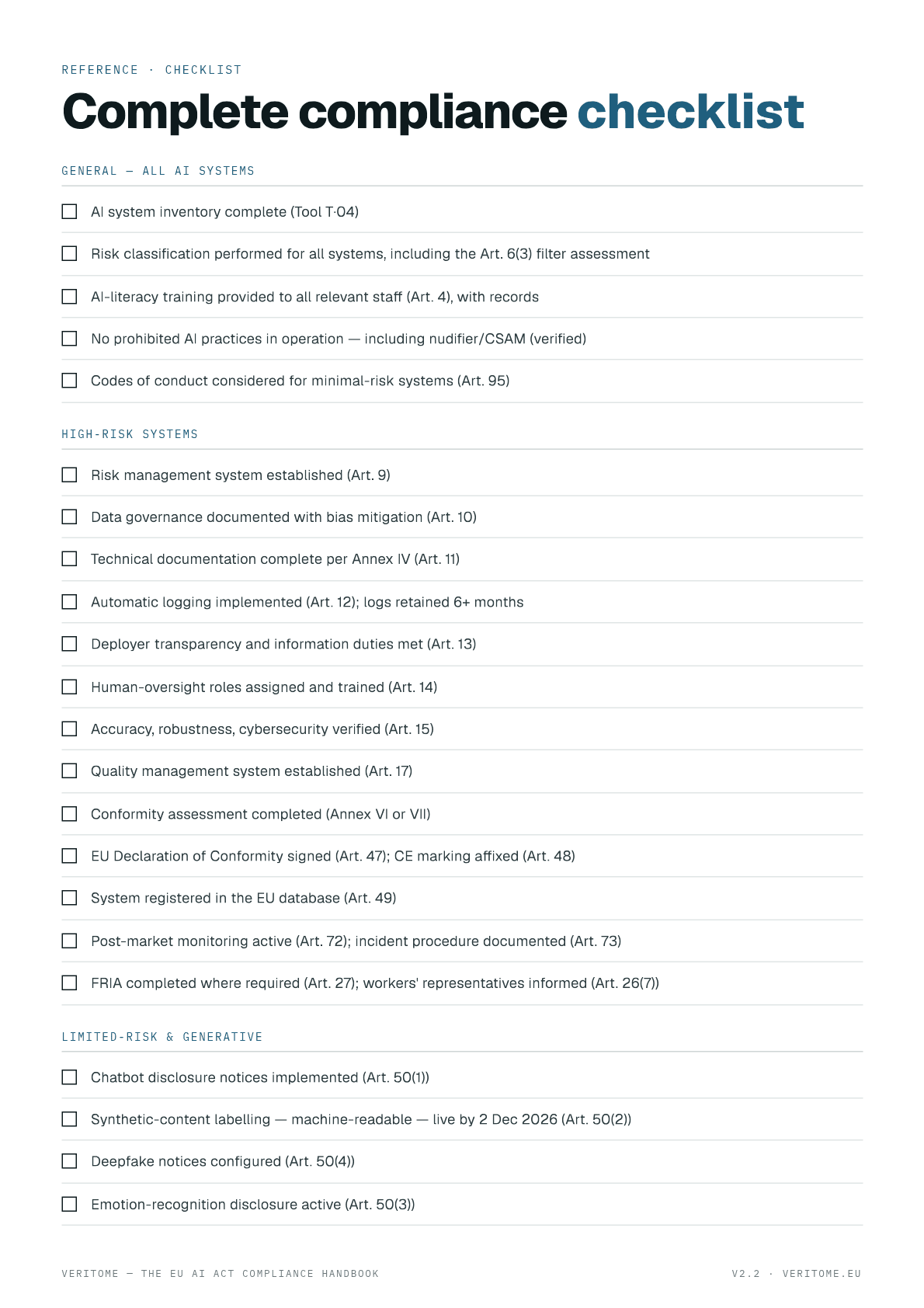
Art. 4Art. 53Art. 86Art. 99The thing you complete, not the thing you read. Four of the six are the headline addition in v2.2.
Looking for the download? The form is at the top of the page.